








The BrainDance AI Lab Pilot Process

De-risk AI before it ever touches production.

Deploying AI without testing it first isn’t a strategy — it’s a bet. The BrainDance AI Lab exists to remove that bet from the equation: a structured pilot process that validates every AI application inside a secure, tailored environment before it ever reaches live operations, using a deliberate mix of governed real data and synthetic or sample data sets to cover cases production data can’t safely show us. What follows is exactly how that process runs, phase by phase.

What We Do

BDP-6™ Methodology

A proprietary six-phase framework moves AI from idea to production with discipline, not improvisation. Every engagement follows the same sequence and passes through one formal governance gate before anything touches a live environment. The result is a repeatable path to deployment you can stand behind.

Test Bed Versatility

One methodology, deployed on your terms — fully off-premises, or isolated inside your own environment. The choice is driven by your data sensitivity and governance posture, not by what’s convenient for us. Either way, the phases and the gate are identical.

Data Strategy

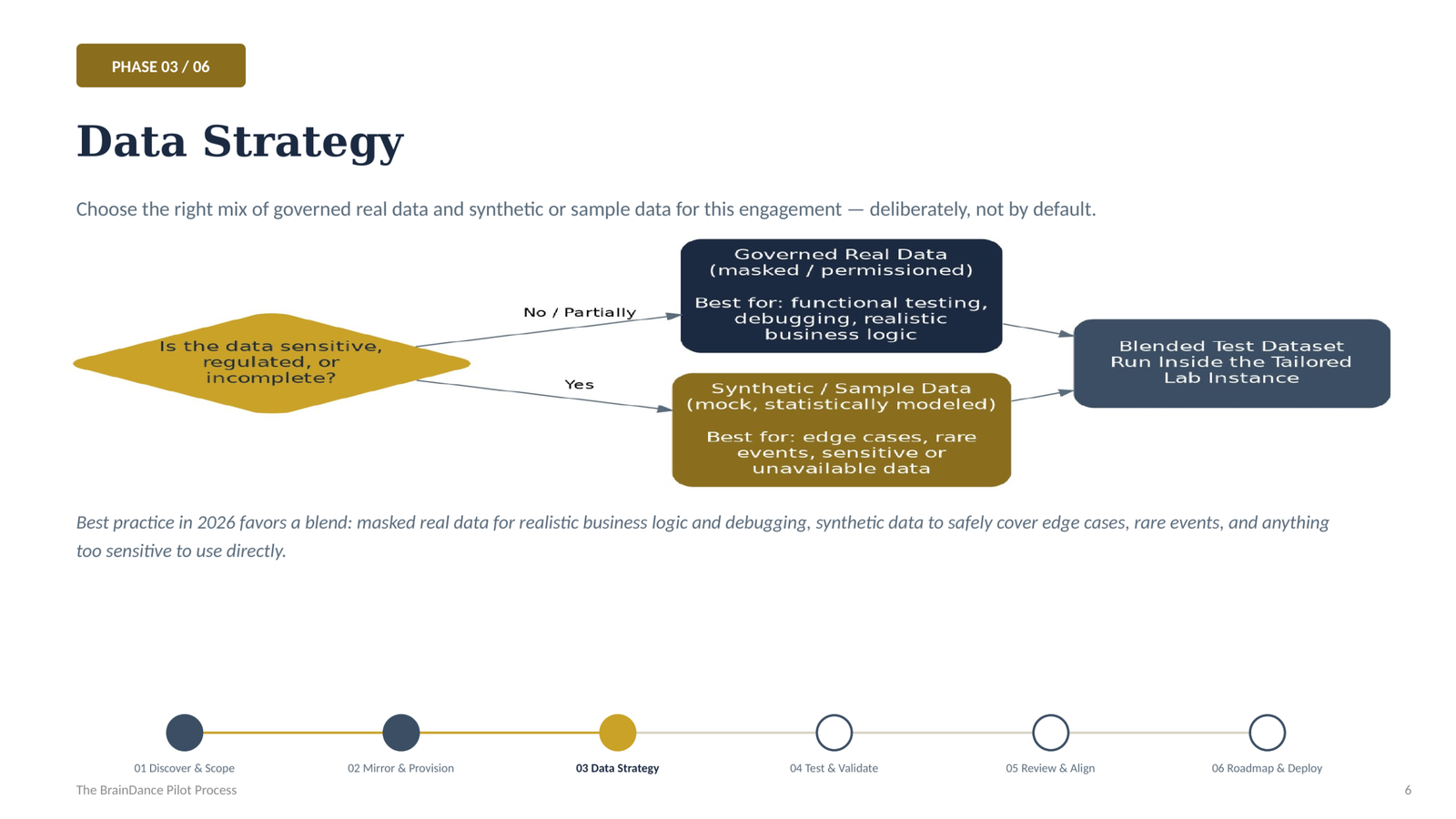
Testing an AI application doesn’t require exposing your most sensitive data to risk. Every data element is routed by sensitivity tier — governed real data where it’s safe, synthetic data everywhere it isn’t. The result is a test corpus that’s both realistic and defensible.

Outcome Validation

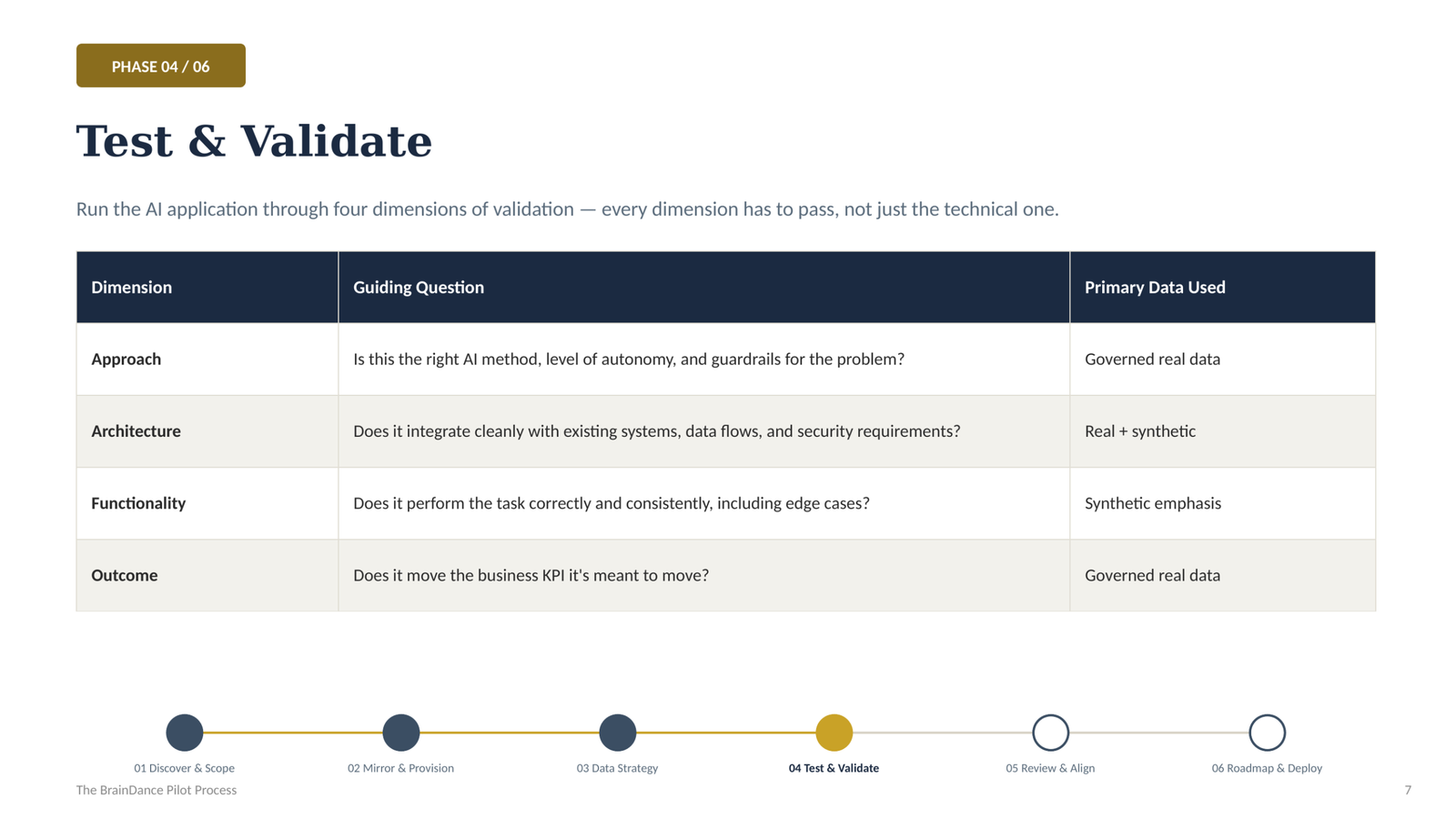
An AI application earns its way to production by passing a structured, four-dimension evaluation — not a one-off demo. Approach, architecture, functionality, and outcome are each tested with purpose-built technical methods. The results roll up into a single, defensible score.

Deployment Roadmap

Validated AI doesn’t go live all at once — it earns production exposure in stages, the same way engineering teams ship code. A phased rollout plan controls exactly how much of your business sees the application, and when. Nothing scales faster than the evidence supports.

AI Lab Process Architecture

Every BDP-6 engagement runs on the same reference architecture, whether it’s hosted off-premises or provisioned inside your own network. Only the physical location of one layer changes — everything else stays constant. That consistency is what makes the methodology repeatable.

Governance & Ownership

Every BDP-6 engagement runs on the same reference architecture, whether it’s hosted off-premises or provisioned inside your own network. Only the physical location of one layer changes — everything else stays constant. That consistency is what makes the methodology repeatable.

Readiness Index

A single, auditable score replaces gut-feel sign-off at the moment it matters most. The BrainDance Readiness Index™ gives every stakeholder — technical or not — one number to evaluate. It’s the evidence the Go/No-Go decision rests on.

Lab Scoping

Every engagement starts with a conversation, not a contract — a BrainDance Project Manager and your technical sponsor build the plan together, backed by a proprietary sensitivity-classification and KPI-instrumentation engine most consultancies can’t replicate. Nothing gets built until that plan is right.

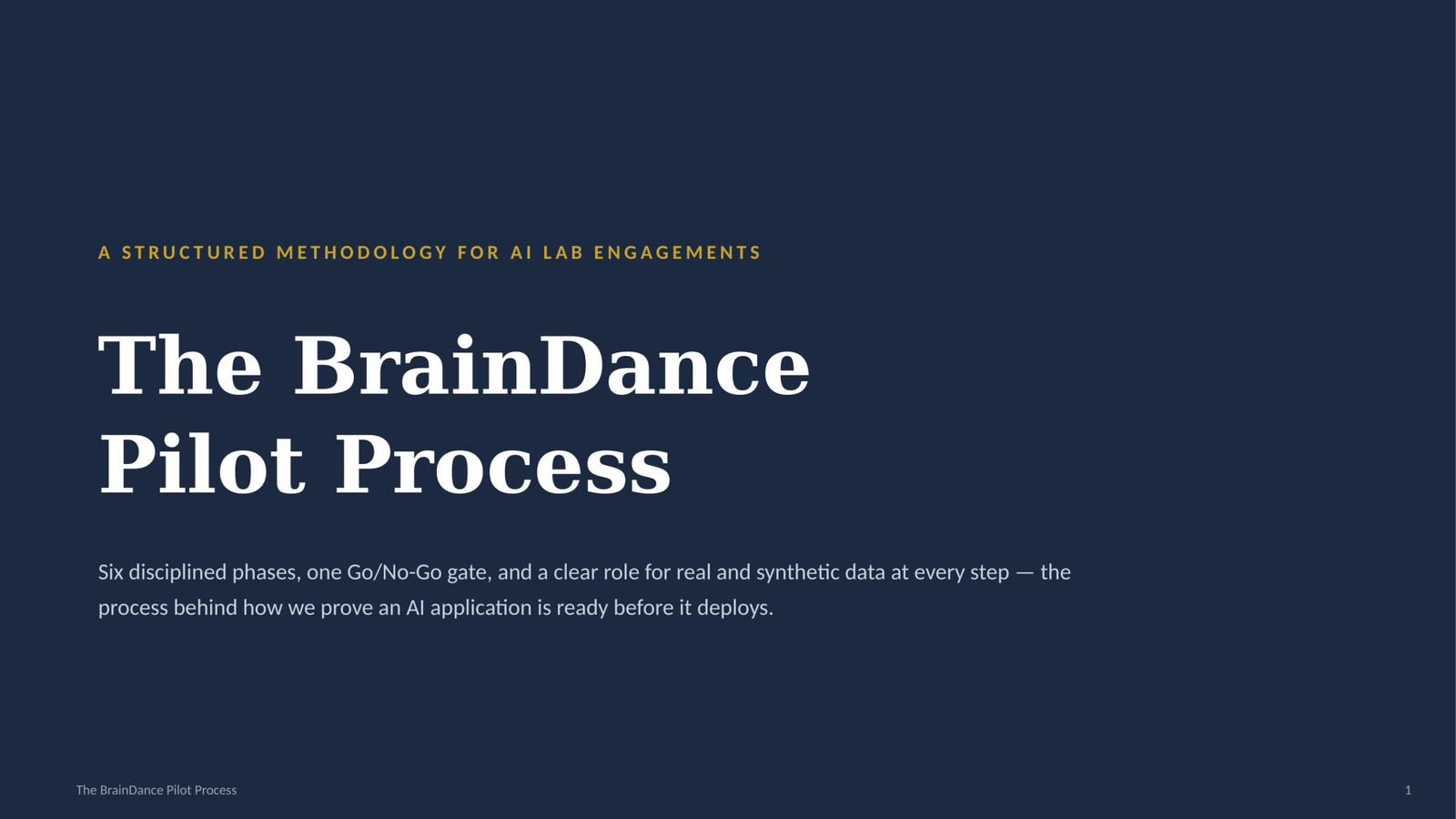
Every organization we talk to has an AI story that stalled somewhere between a promising demo and a real deployment. The BrainDance AI Lab Pilot Process exists to close that gap. It's not a pitch deck or a one-off workshop — it's the actual, repeatable methodology we run for every client, start to finish: six disciplined phases, a formal decision gate, and a clear plan for using both governed real data and synthetic or sample data along the way. What follows is a walkthrough of exactly how it works.
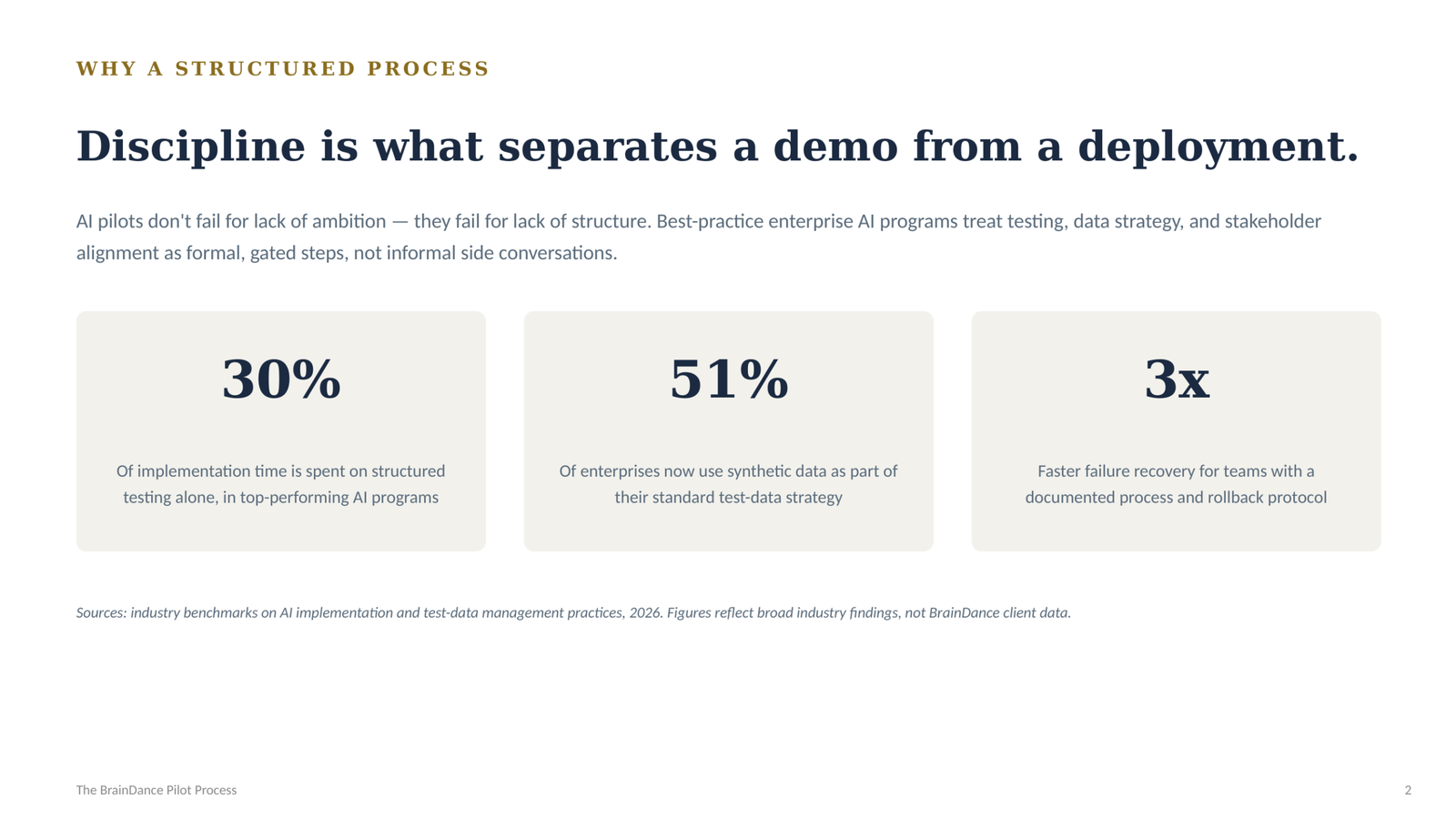
AI pilots rarely fail because the idea was bad. They fail because nobody built in the structure to catch problems early — so issues that should have surfaced in week two show up instead after go-live, when they're expensive and public. The industry data bears this out: the organizations getting real value from AI are the ones treating testing and validation as a formal, gated part of the process, not an afterthought squeezed in before launch.
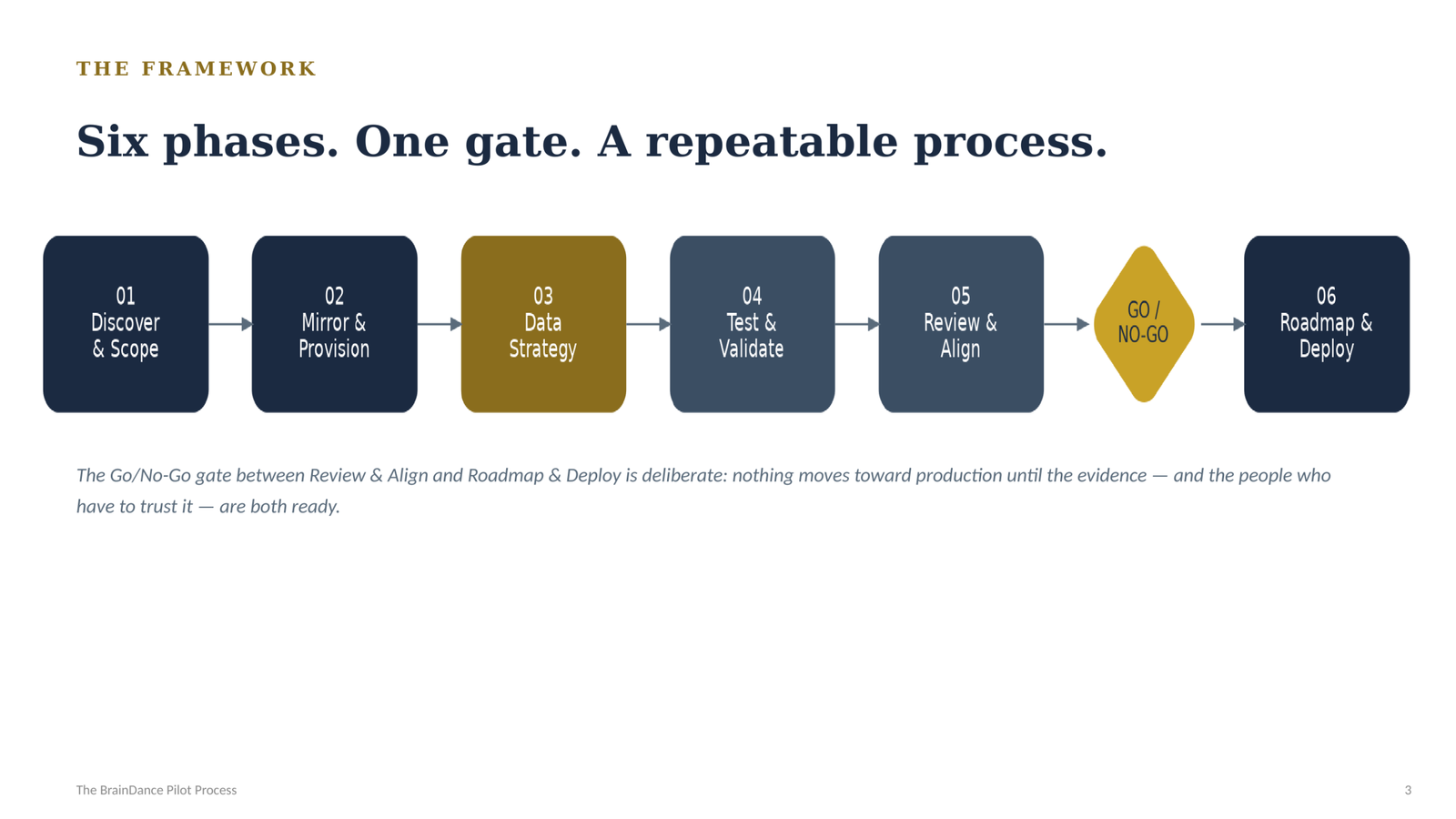
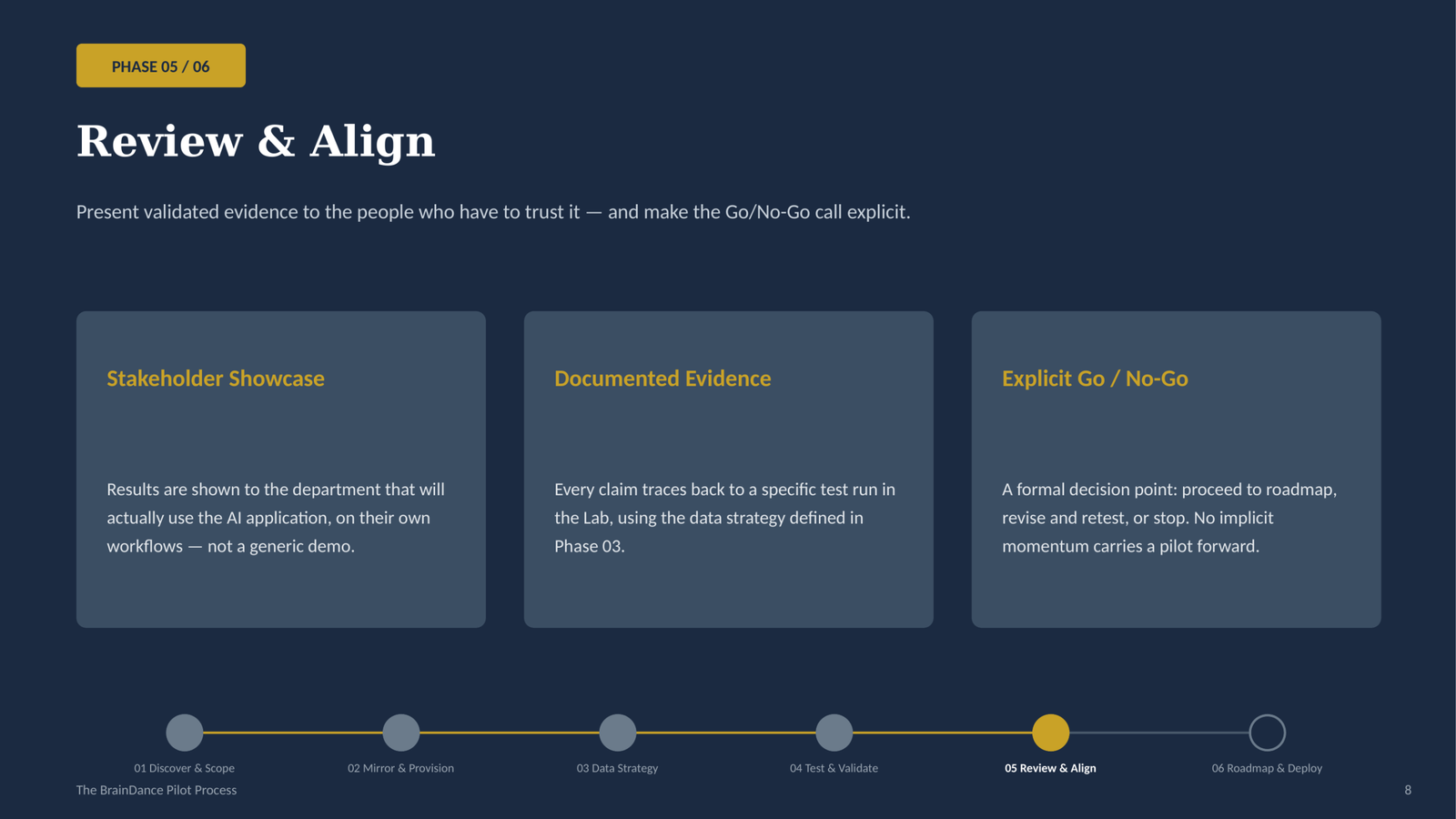
This is the process in full, at a glance. Six phases carry an AI application from a rough idea to a validated, ready-to-scale system — and one deliberate checkpoint, the Go/No-Go gate, sits between validation and deployment. Nothing moves past that gate on momentum alone. The sections below walk through each phase in detail: what happens, who owns it, and what has to be true before the process moves forward.
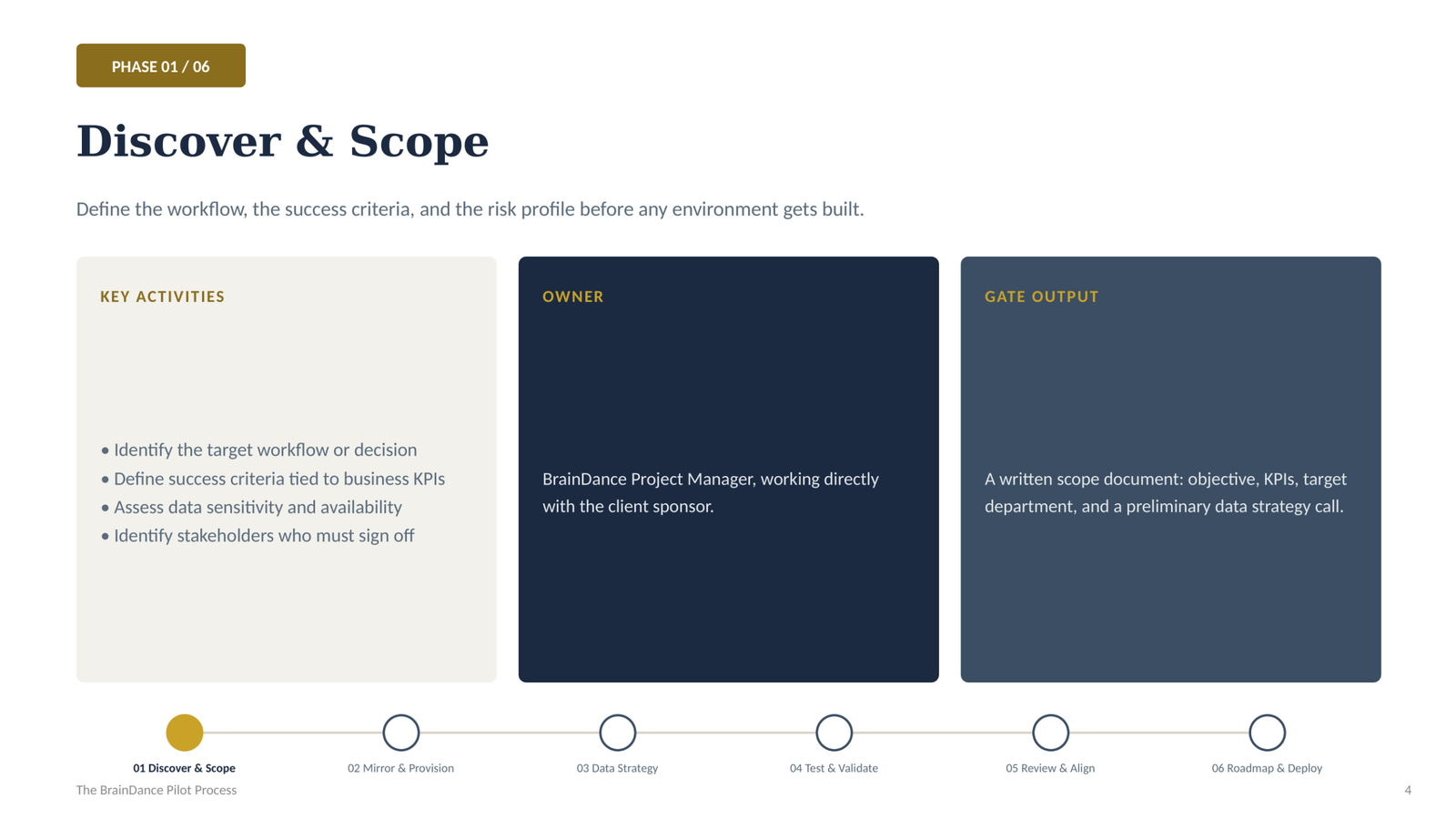
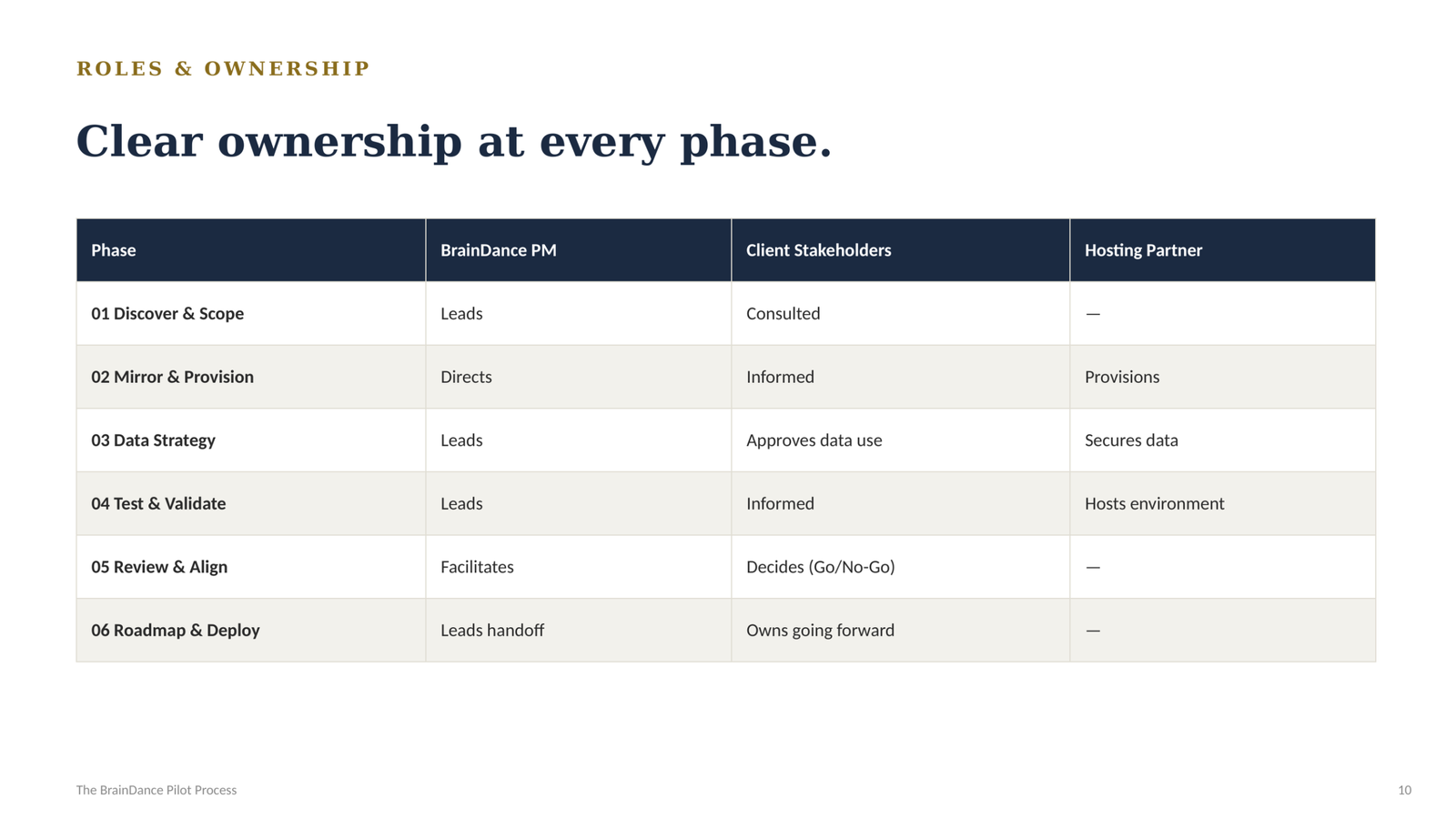
A process is only as reliable as the clarity of who owns each step. This table is deliberately simple: at every phase, it's clear whether BrainDance is leading, the client is deciding, or the hosting partner is executing. That clarity is what keeps engagements moving — there's never a moment where a decision stalls because it's unclear whose call it is.
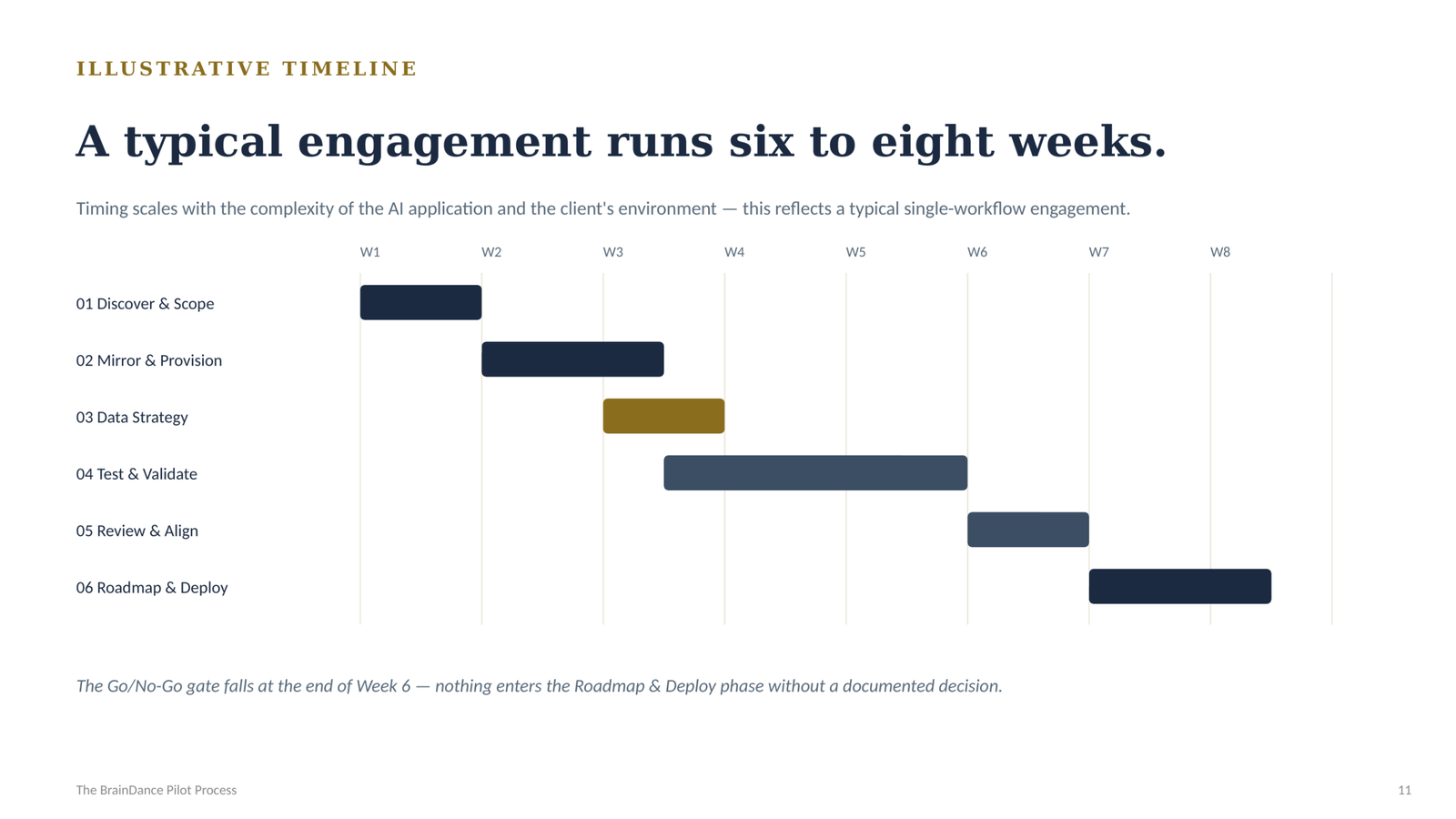
In practice, a single-workflow engagement runs six to eight weeks from kickoff to a rollout-ready roadmap. More complex applications, or engagements spanning multiple departments, run longer — but the sequence and the gate stay the same. Predictability is part of the point: clients know roughly what to expect going in, which is itself part of what builds confidence in the process.
The BrainDance AI Lab Pilot Process is how we turn “we think this AI application could work” into “we've proven it does, and here's the plan to roll it out.” If your organization is weighing an AI investment and wants evidence before commitment, this is the process that gets you there.


Empower Your Organization with Actionable Insights

BrainDance provides applied research, growth intelligence, and decision-ready analytics for executives.

Explore curated frameworks, dashboards, and tools that turn raw data and organizational experience into measurable, repeatable outcomes. BrainDance equips teams with insights that inform strategy, accelerate execution, and improve operational performance.

Our Approach

Operational planning, strategy review, and analytics in action

Case Studies in Applied Insights

Discover how BrainDance translates complex challenges into actionable solutions, providing measurable impact across multiple sectors.

Predictive Funds Model – Federal Agency

Problem: Manual fund collection processes delayed cashflow and reduced compliance visibility.
Solution: Implemented predictive modeling to forecast fund collection probability, improving operational efficiency and enabling proactive interventions.

Empowered Growth

Why Executives Leverage Applied Insights

Evidence-Based Decision Making

Turn disparate data into clear, actionable intelligence. Transform reporting into foresight that guides execution.

Operational Visibility & Alignment

Align teams, resources, and initiatives with strategy through real-time dashboards, KPI monitoring, and structured governance.

Accelerated Learning & Improvement

Rapidly test hypotheses, validate strategies, and apply lessons across programs to capture measurable value.

AI & Technology Enablement

Leverage AI, automation, and predictive analytics to amplify execution, reduce manual overhead, and scale insights across teams.

BDP-6™ Methodology

Each of the six phases produces a signed artifact — a scope document, a provisioning manifest, a data lineage record, a validation report — building an evidentiary trail from day one. The Go/No-Go gate sits at the center of the methodology: nothing advances on momentum, enthusiasm, or a confident demo alone. A Conditional-Go is logged with named remediation items and a firm re-test date; a No-Go halts the engagement before any production exposure. Because the framework is fixed and named rather than improvised per client, every stakeholder — technical and non-technical — can see exactly where an engagement stands at any moment. That consistency is what lets BrainDance move fast without cutting corners.

Test Bed Versatility

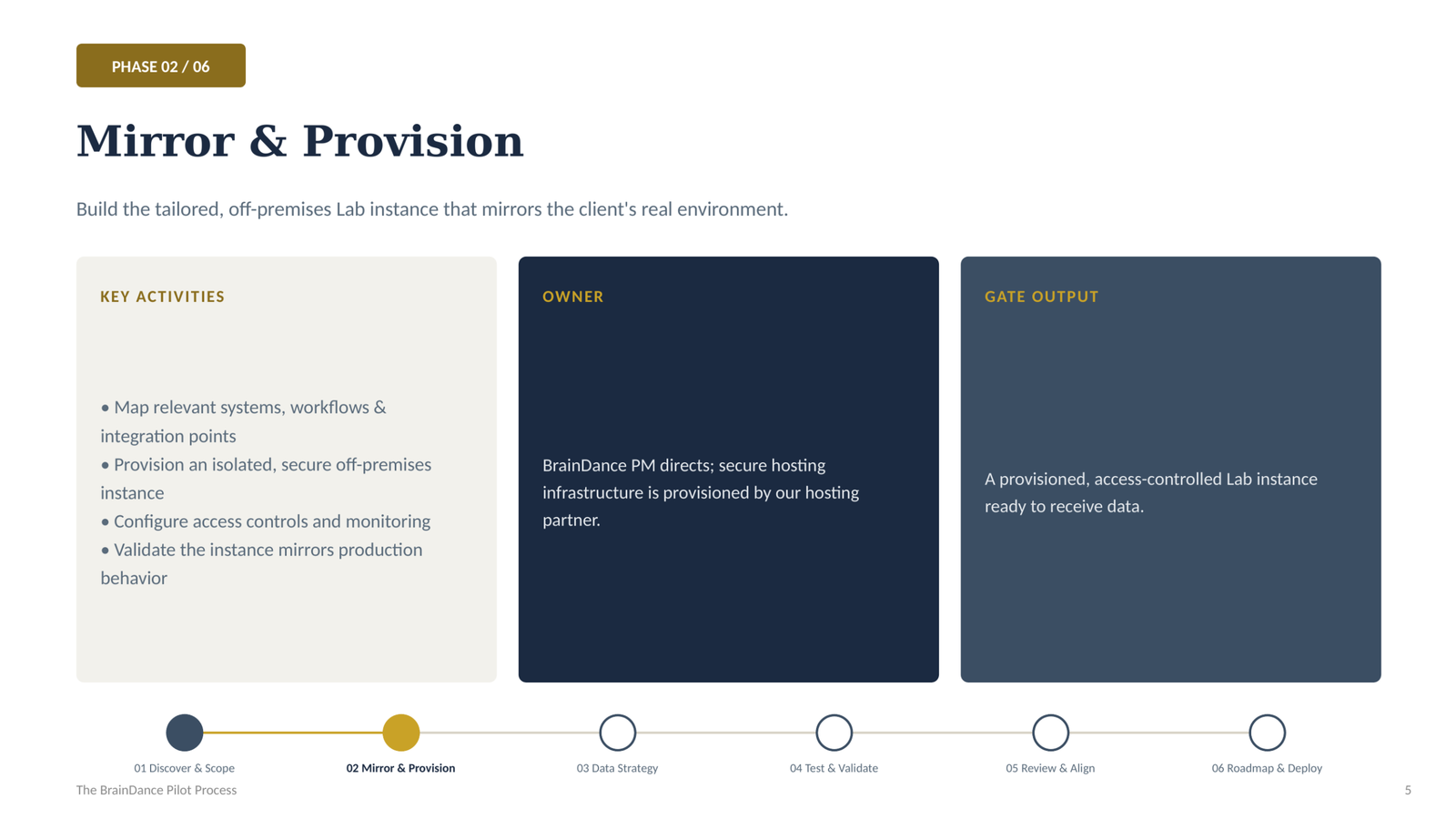
The Lab is a provisioning pattern, not a fixed location. An off-premises managed instance is the fastest path to a pilot — single-tenant, hosted and secured by our partner, with zero demand on your infrastructure team. An on-premises provisioned segment instead runs inside your own network on a dedicated VPC or VLAN, with scoped IAM and no default route to production, and can be deployed fully air-gapped where sovereignty or classification requires it. A Hybrid Bridge configuration is also available: governed data and orchestration stay on-premises while synthetic-data workloads burst to the off-premises Lab through a controlled, one-way gateway. Whichever model fits, your data residency and infrastructure control are never in question.

Data Strategy

Governed real data moves through masking, tokenization, and field-level exclusion according to its sensitivity tier, preserving the realistic business logic needed for functional testing and debugging. Synthetic data — built through statistical modeling, rules-based generation, or generative synthesis — fills in the edge cases, rare events, and anything too sensitive to use directly. The two streams blend into a single test corpus that runs entirely inside the provisioned Lab instance. Every field in that corpus is traced back to its source — real-masked or synthetic — and its generation method, producing a Data Lineage Record that holds up at audit. You get the coverage of real-world data without the exposure.

Outcome Validation

Approach is tested through prompt and model ablation and guardrail red-teaming to confirm the right method and autonomy level were chosen. Architecture is validated with API contract tests and latency and throughput benchmarks to confirm clean, secure integration. Functionality is stress-tested with adversarial suites run against the synthetic corpus, plus regression runs for consistency. Outcome is measured in shadow mode, comparing live performance against baseline before any user ever sees it. The weighted composite of all four dimensions becomes the BrainDance Readiness Index™ — the number that carries into the Phase 05 gate review.

Deployment Roadmap

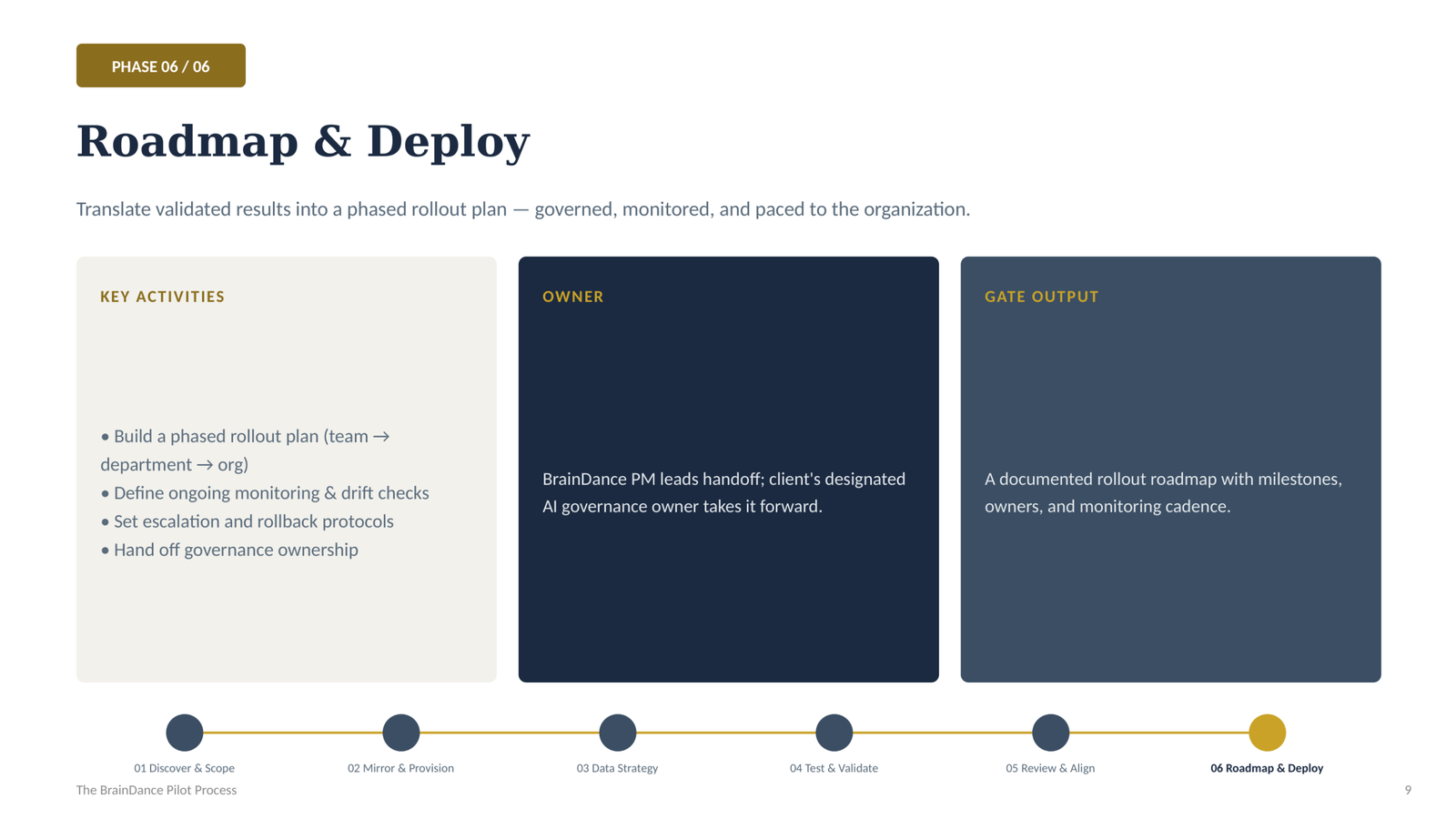
The rollout moves through four defined stages: Lab-validated, a 5% canary cohort, a 25% expanded cohort, and finally 100% full production. Drift monitoring runs continuously at every stage, watching for performance or behavior that strays from what was validated. An automatic rollback trigger is built into the plan — a threshold breach reverts the cohort to the prior stage immediately, without waiting on a manual call. BrainDance leads the handoff, and governance ownership transfers formally to your team along with a monitoring runbook and named thresholds. The same discipline that governed the pilot now governs the rollout.

AI Lab Process Architecture

Client systems and source APIs feed into a data fabric blending real-masked and synthetic data, which in turn feeds isolated Lab compute — the layer that moves between off-premises and on-premises deployments. From there, an evaluation harness applies the four-dimension rubric, a governance gate enforces the Go/No-Go decision, and a promotion pipeline carries validated applications into production. Audit logging and observability span every layer and every phase, not bolted on afterward but built into the architecture from the start. The result is a single, coherent stack your technical team can actually diagram and defend internally.

Governance & Ownership

A defined responsibility structure runs across all six phases, naming BrainDance’s role, your stakeholders’ role, and the infrastructure owner’s role — distinguished further by topology, whether that’s our hosting partner off-premises or your own IT team on-premises. BrainDance directs provisioning, leads data strategy and testing, and facilitates the final review; your stakeholders consult, approve data use, and ultimately decide Go or No-Go. Infrastructure owners — whichever topology applies — secure the environment, enforce data residency, and host the segment or instance. Critically, BrainDance retains sole authorship of the Go/No-Go recommendation in every scenario: infrastructure ownership never confers decision rights over the gate. That separation keeps the validation honest, regardless of who’s hosting.

Readiness Index

The Index is a weighted composite built from the four validation dimensions tested in Phase 04: approach, architecture, functionality, and outcome. Rather than asking stakeholders to interpret a stack of raw test logs, the Index distills that evidence into a score out of 100 that’s easy to communicate and hard to dispute. It carries directly into the Phase 05 Review & Align gate, where it anchors the Stakeholder Scorecard and the final Signed Decision Record. Because the scoring methodology is fixed and repeatable, the Index also lets you compare readiness across multiple pilots over time — not just pass or fail one at a time. It’s the proprietary artifact that turns validation into a defensible business decision.

Lab Scoping

Scoping decomposes the target workflow into discrete decision points and tool-call boundaries, so success is defined by instrumented KPIs rather than vague goals. Data is classified into a formal sensitivity tier — Public, Internal, Regulated, or Restricted — which drives the topology recommendation that follows. Stakeholders and the named Go/No-Go approver are identified before work begins, so there’s no ambiguity later about who ultimately decides. The call concludes with a signed Scope & Risk Classification record: the target workflow, the KPI instrumentation plan, the data-sensitivity tier, and a preliminary topology recommendation. It’s the foundation every other phase builds on — get this right, and everything downstream moves faster.